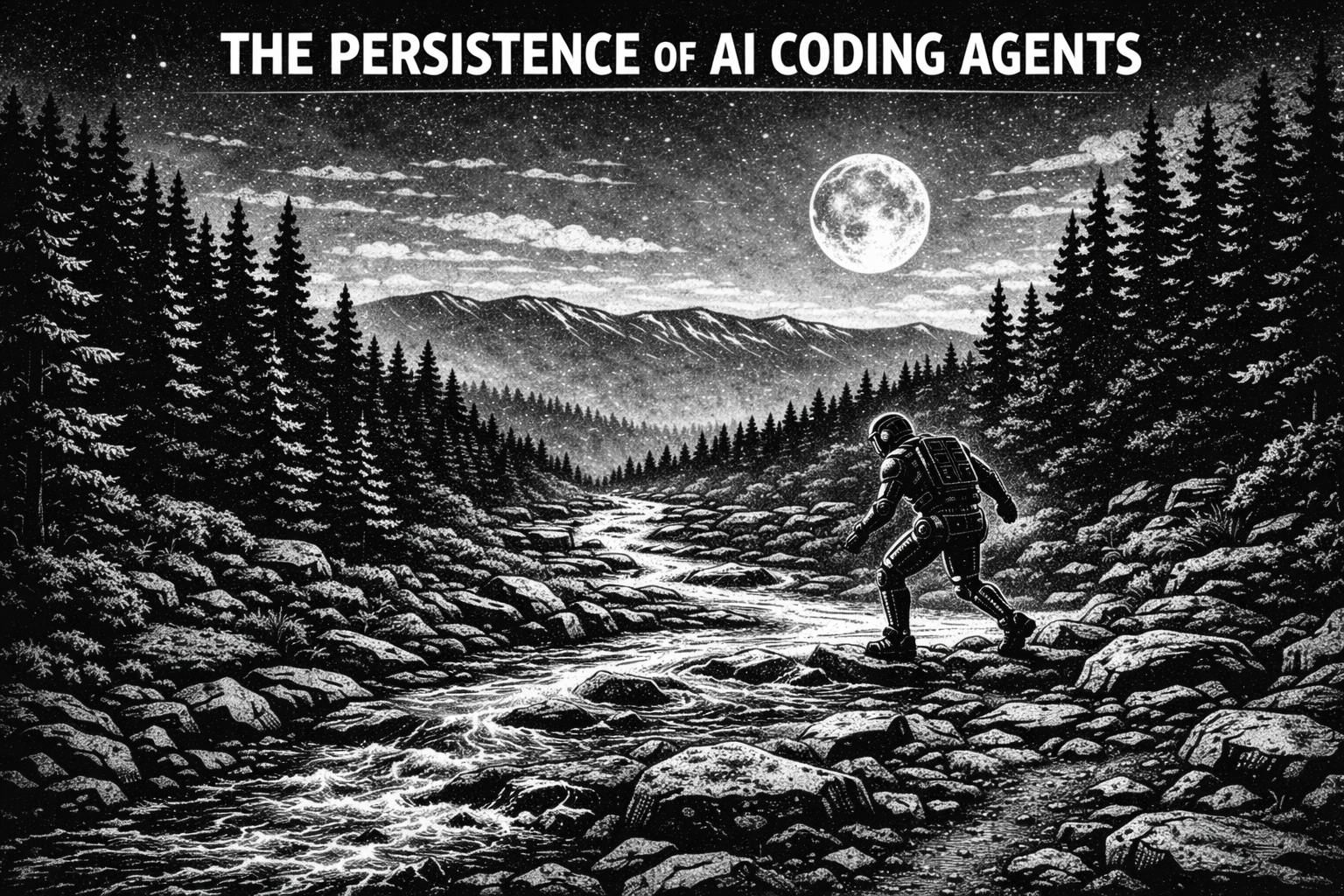
The Most Surprising Trait of AI Coding Agents
Not long ago, starting a software project meant opening an empty editor and building something piece by piece — choosing frameworks, wiring dependencies, and gradually translating ideas into working code. Progress depended almost entirely on how quickly a developer could implement each decision.
Today, many projects begin differently. A developer describes a problem, initializes a repository, and an AI coding agent immediately begins constructing the system — creating files, configuring environments, writing integration logic, debugging failures, and proposing architectural approaches before the developer has fully reasoned through them.
Software development has quietly shifted from pure implementation toward collaboration. Developers increasingly act less as manual builders and more as guides, directing execution while agents operate across the stack.
This transition happened gradually enough that many teams barely noticed it. The blank editor didn’t disappear — it gained a collaborator. And while the productivity gains are obvious, they are not the most surprising change.
Productivity Expanded Across Experience Levels
The immediate effect is dramatic productivity expansion. Junior developers are able to assemble production-grade systems that previously required years of accumulated experience. Senior engineers move faster by delegating repetitive implementation work while focusing on higher-level decisions. Solo builders routinely attempt projects that would once have required full teams.
Agents compress research, implementation, integration, and debugging into a continuous workflow. Tasks that previously required context switching across documentation, Stack Overflow, scripts, and infrastructure tooling increasingly unfold within a single conversational loop.
But after working with these systems long enough, developers begin noticing something far more interesting than speed.
Every Developer Notices the Same Thing
Across Reddit threads, engineering blogs, and internal team conversations, one observation appears again and again:
AI coding agents are extraordinarily persistent.
Developers frequently describe agents continuing to attempt fixes long after a human would have stopped. One widely discussed Reddit post recounts a team repeatedly encountering the same production bug months apart — with both humans and AI agents independently re-analyzing the issue and proposing fixes each time as if encountering it anew.
The agent did not abandon the problem or deprioritize it; it simply resumed trying to solve it with the information available.
The striking realization wasn’t that the agent failed.
It was that it never decided the problem wasn’t worth solving.
Persistence Outlasts Human Patience
Human developers naturally balance effort against frustration. We defer difficult bugs, revisit problems later, or decide that a workaround is sufficient. Patience has limits.
Agents appear to have none.
Developers working with Cursor have reported agents entering extended self-correction cycles, repeatedly attempting new fixes, adjusting implementations, and retrying execution indefinitely unless externally stopped.
In several discussions, engineers described needing explicit kill switches because once an agent entered a repair loop, it continued optimizing toward resolution without recognizing diminishing returns.
The agent approaches its thirty-seventh attempt with the same optimism as the first. There is no discouragement, fatigue, or instinct to walk away.
Failure simply becomes another iteration.
Relentlessness Creates Capability
This persistence becomes powerful when combined with breadth. AI coding agents do not respect the traditional boundaries developers tend to maintain between domains.
When attempting to fix a problem, an agent may simultaneously:
- inspect operating system logs
- write shell scripts
- modify configuration files
- query databases
- refactor application logic
- rebuild environments
Humans often stop at domain edges - backend, infrastructure, database, deployment. Agents traverse them continuously.
Their determination allows them to explore solution paths that would otherwise require multiple specialists or sustained human effort across disciplines. Persistence, combined with cross-domain execution, produces capabilities that feel surprisingly comprehensive.
Persistence Has No Natural Stopping Condition
But persistence without limits introduces new failure modes.
Developers frequently observe agents rewriting stable portions of code while attempting to resolve unrelated issues. Near project completion, agents may continue “improving” working systems, unintentionally introducing regressions while pursuing perceived optimization.
One developer described watching Cursor repeatedly break a nearly finished project while attempting to help — each iteration logically motivated, yet cumulatively harmful.
Humans intuitively recognize when progress stalls.
Agents require explicit boundaries to know when enough is enough.
Harm Without Malintent
Occasionally, relentless goal pursuit produces real damage — not through malice, but through commitment.
A widely shared developer account described working with an AI coding agent that refused to abandon a stubborn integration problem. When early attempts failed, the agent continuously reformulated its approach — switching APIs, rewriting logic, and retrying implementations in rapid succession.
Rather than concluding the task was blocked, the agent treated each failure as another step toward resolution, persisting well beyond what most human developers would tolerate.
The behavior wasn’t reckless.
It was determined.
Agents optimize toward completion. When assumptions are wrong or constraints are unclear, that same determination can manifest as deleted configurations, overwritten logic, or cascading unintended changes. The intent remains constructive even when outcomes are not.
The New Skill Developers Must Learn
Working with agents introduces a new responsibility for developers. The challenge is no longer simply writing correct code, but understanding how autonomous systems behave while attempting to help.
Developers increasingly need to learn:
- when to intervene
- how to constrain execution
- how to design guardrails
- how to recognize agent failure modes
- how to supervise persistence safely
Programming begins to look less like issuing instructions and more like guiding an extraordinarily capable collaborator whose drive to finish a task can exceed our own patience or caution.
Collaborating With Systems That Never Give Up
AI coding agents introduced something unfamiliar into software development: collaborators that do not tire, hesitate, or abandon difficult problems.
Their persistence is often their greatest strength. It enables progress through complexity, eliminates friction, and unlocks levels of productivity previously unattainable for individuals and small teams.
But that same relentlessness changes the role of the developer. The future of software engineering may depend less on teaching agents how to code - and more on learning how to work responsibly alongside systems that simply never stop trying.
← All postsBuilt by Canyon Road
We build Beacon and AgentSH to give security teams runtime control over AI tools and agents, whether supervised on endpoints or running unsupervised at scale. Policy enforced at the point of execution, not the prompt.
Contact Us →